Opinion: The Eurovision Asia entries that share traits with Contest favourites


Opinion by Aussievision contributor Michael Montenegro
Some of the entries competing at the inaugural Eurovision Asia are taking similar musical approaches to songs we've seen at the Eurovision Song Contest.
From repeated hooks and powerful vocals to genre changes and duets, there are interesting parallels between this year's Asian entries and songs from previous Eurovision contests.
We take a look at those similarities and what they could mean when the artists perform in Bangkok on 14 November.
Finland's Cha Cha Cha and Laos's BAE
Käärijä's Cha Cha Cha demonstrated how a repeated hook can become increasingly exciting through rhythmic contrast, musical escalation and distinctive choreography.
Its instantly recognisable refrain helped Finland secure 376 televote points in 2023, winning the public vote despite finishing second overall.
Thinla's BAE offers a comparable opportunity with its infectious refrain, energetic production and blend of contemporary pop with Lao morlum influences creating an accessible yet distinctive musical identity.
The challenge is maintaining momentum, as repetition becomes compelling when each return introduces greater intensity, whether through arrangement, vocal delivery or choreography.
Like Cha Cha Cha, BAE could become a televote favourite if its strongest hook develops into a memorable three-minute performance rather than remaining a repeated musical phrase.
Sweden's Tattoo and Malaysia's Bluest Sky
Loreen's Tattoo combined emotional restraint, controlled vocal intensity and carefully developed staging to win Eurovision 2023, supported by a commanding jury result of 340 points.
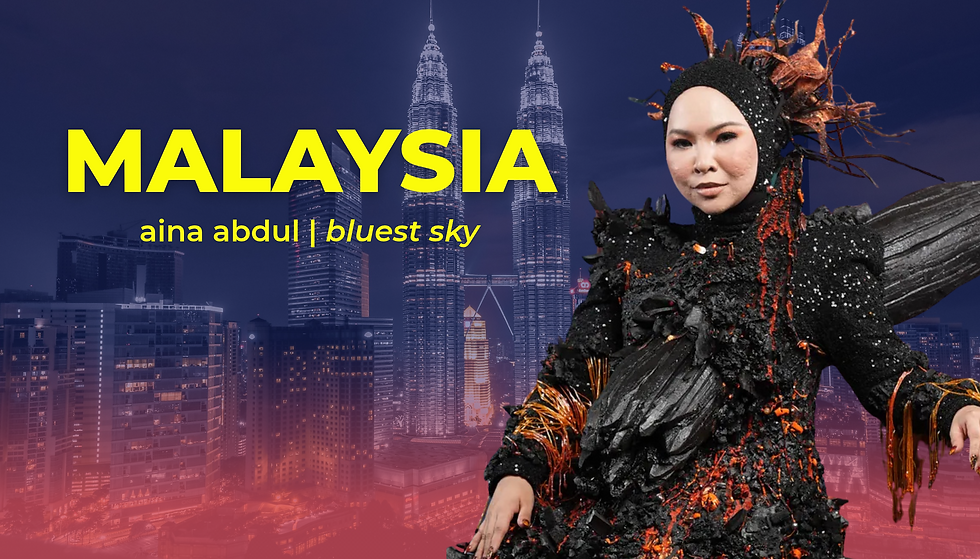
Malaysia's Bluest Sky, credited to Aina Abdul and Mac Chew, similarly emphasises emotional contrast and demanding vocal interpretation.
In Malay-language interviews, Aina described a ten-hour recording process and the difficulty of expressing anger, love and sadness within three minutes.
The song's visual identity has also developed through a music-video costume inspired by a black betta fish, symbolising strength, vulnerability and transformation.
These elements suggest an ambitious emotional narrative, although the music-video concept should not be mistaken for confirmed Grand Final staging.
Like Tattoo, Bluest Sky may appeal strongly to professional jurors if its vocal difficulty serves a coherent emotional progression.
Restraint could prove as important as vocal power.
Switzerland's The Code and the entries from South Korea and Vietnam
Nemo's The Code integrated contrasting musical styles, demanding vocals and a rotating-platform performance into a coherent narrative.
The composition won Eurovision 2024, receiving 365 jury points.
South Korea's JUNHEE explores a different form of complexity with DEEP DIVE, a pop-EDM composition built around emotional immersion and increasing intensity.
His involvement in the song's writing and composition strengthens the connection between its concept and performance.
The opportunity lies in aligning choreography with musical development, as technical precision alone is insufficient if movement distracts from the melody.
Vietnam's Tóc Tiên approaches complexity through musical fusion in EM TIÊN.
According to an HTV report from 24 October, producer S•HUBE drew inspiration from a Vietnamese folk melody associated with the phrase "em Tiên, dạo bước í à nơi đây", reinterpreting it in EM TIÊN through the line "yêu nhau cởi áo í à cho nhau" and a contemporary electronic arrangement.
Created by S•HUBE's DUONGK and HAROSE, EM TIÊN provides a concrete example of traditional melodic material being reinterpreted through contemporary electronic production.
While South Korea and Vietnam take different musical approaches, both entries offer parallels with the way The Code combined contrasting elements within a single performance.
The Code demonstrates that musical contrasts succeed when they serve one artistic idea.
South Korea must connect technical performance with narrative development, while Vietnam must ensure that its folk-derived melody and electronic production form a unified composition.
Croatia's Rim Tim Tagi Dim and the Philippines' Sobra-Sobra
Baby Lasagna's Rim Tim Tagi Dim combined an unmistakable rhythmic hook, contemporary production and culturally distinctive imagery.
Croatia won the 2024 public vote with 337 points, finishing second overall.
The Philippines' Sobra-Sobra, written by Nica del Rosario and Mat Olavides, similarly draws strength from rhythmic immediacy.
Its arrangement incorporates rap, powerful vocals and Filipino instrumental elements, including kulintang and kubing.
Both songs bring together contemporary production and cultural influences, with their rhythms playing a major part in their appeal.
The challenge is structural unity, as multiple musical influences can create originality, but only when they contribute to a recognisable central identity.
Like Croatia's entry, Sobra-Sobra could gain public support through rhythmic energy and cultural distinction.
Its effectiveness will depend on whether the musical contrasts reinforce the song rather than compete for attention.
Portugal's Amar pelos dois and the ballads from Cambodia and Nepal
Salvador Sobral's Amar pelos dois won both the jury and public votes in 2017 through melodic interpretation, emotional sincerity and restrained staging.
Cambodia's Monetrey offers a similar opportunity with I Let You Go, an atmospheric ballad selected on 17 October.
His interest in cinematic storytelling could produce a distinctive presentation, provided the visuals do not overwhelm the song.
Nepal's Pratik Himal Rai faces a related challenge with Ananta Maya, a composition centred on enduring love.
Both Asian ballads depend on sustaining emotional engagement through melody, phrasing and controlled musical development rather than elaborate choreography or constant changes in production.
Portugal demonstrated that intimacy can command an arena, and Cambodia and Nepal could benefit from the same principle if their live performances prioritise melody and emotional clarity over unnecessary spectacle.
Azerbaijan's Running Scared and Thailand's Aroma
Azerbaijan's Running Scared won Eurovision in 2011, with Ell & Nikki demonstrating how two performers can create a musical relationship through contrasting phrases, harmonies and shared emotional development.
Thailand's MANG x DAOU will compete with Aroma, making the duet format central to its artistic identity.
Like Running Scared, the Thai entry puts the interaction between two performers at the centre of the song.
The strongest arrangement should give each singer a distinct role while allowing their voices to interact meaningfully.
Like Running Scared, Aroma must establish chemistry through the composition itself.
Two recognisable performers are not automatically more compelling than one, and their musical interaction must justify the format.
Bangladesh, Bhutan and Mongolia: Different approaches
Not every Asian entry has a close counterpart among Eurovision's best-known winners, with Bangladesh, Bhutan and Mongolia offering three different approaches to the competition.
Bangladesh's Beatmosphere uses a cappella singing and beatboxing to create melody, harmony, bass and percussion in Tumi Ele.
Its six-member competition configuration offers a distinctive musical structure, but the technical arrangement must support the song's central melody.
Bhutan's Nyendra will compete with Lhayi Semo, selected through Rhythm of Bhutan, with the song's opportunity lying in communicating a distinctive musical identity without sacrificing melodic accessibility.
Mongolia's Beck will perform Chamguigeer (Without You), which replaced Light after the original song was ruled ineligible under the contest's pre-1 July 2026 eligibility requirement.
The replacement composition requires its own musical assessment and staging concept rather than relying on the original selection result.
While these entries don't have the same direct comparisons with previous Eurovision winners, they reflect the contest's broader tradition of rewarding original songs and performances.
As with past Eurovision entries, originality is valuable when it strengthens the composition, not merely when it introduces an unusual performance format.
Will Eurovision history repeat itself in Asia?
Eurovision has shown that there is no single approach to winning the competition, with everything from intimate ballads to energetic pop songs finding success over the years.
The inaugural Eurovision Asia brings together eleven countries with different musical traditions, languages and approaches to performance, and some of the similarities with past Eurovision entries are particularly interesting.
However, Asia is not one homogeneous music market, with familiarity with languages, genres and performance conventions varying considerably across the region.
A compelling rhythm, memorable melody or emotionally convincing performance can cross cultural boundaries without requiring a song to abandon its identity.
Whether these similarities translate into the same success as their European counterparts remains to be seen when the inaugural Eurovision Asia takes place in Bangkok on 14 November.
For continued updates on all Eurovision Song Contest news, follow us on Facebook, Twitter, TikTok, YouTube, BlueSky, Threads and Instagram. All the links can be found at: https://linktr.ee/aussievisionnet