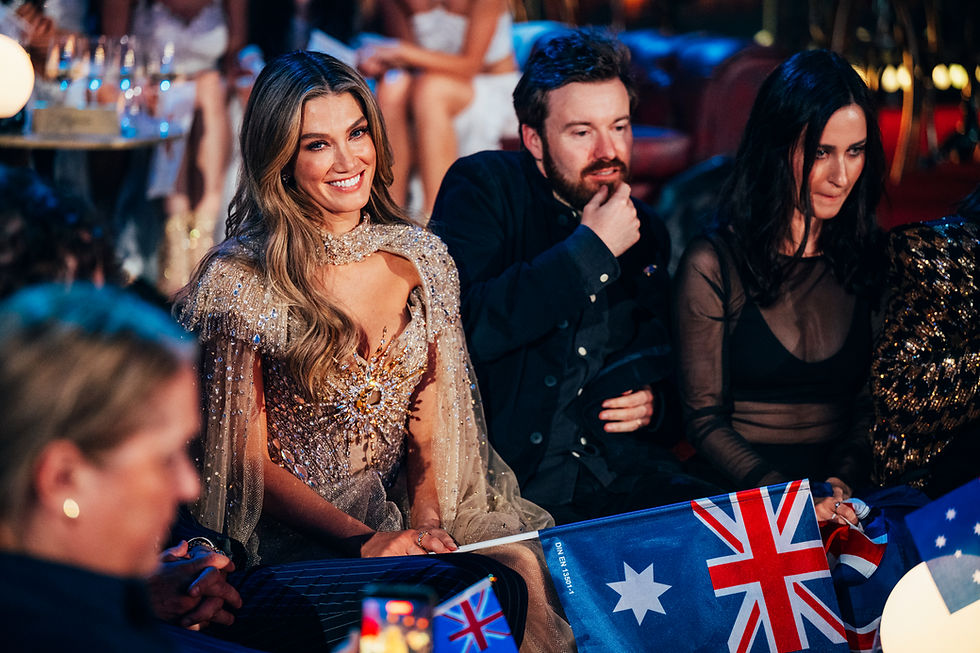
Interview with Australia's Eurovision Head of Delegation Emily Griggs from SBS

Updated: May 1

We chat with Australia's Head of Delegation for Eurovision - Emily Griggs from SBS.
Each broadcaster at Eurovision has a Head of Delegation who oversees their country’s participation and represents them in the Contest’s official decision-making processes.
Since 2022, Emily Griggs has been Australia's official Head of Delegation.
Often making everything work from behind the scenes, we wanted to get to know Emily a little better.
We asked her views on where Australia is in the Contest, how artists are selected, and so much more.
She took time out of her very busy schedule while preparing for Vienna to answer our questions.
For those who may not be familiar, can you tell us a bit about your background and what led you to the role of Head of Delegation?
I’ve ended up in the role of Head of Delegation through my work as SBS’s Head of Entertainment and Food, but really, it’s the result of more than thirty years in television, much of that spent in live production where everything happens in the moment.
That kind of environment shapes you. The stakes are high, there are a lot of moving parts, and you learn quickly how to stay calm, make decisions fast and trust your instincts.
Across that time, my work has spanned every free to air network in Australia, producing and directing a wide mix of programs, including large scale entertainment, live music performances and concerts.
There’s also been the chance to work on major events like the Olympics with Roy and HG, which brings its own energy and unpredictability. Those experiences build a strong sense of timing, storytelling and how to capture a moment that feels both authentic and exciting on screen.
What’s stayed consistent is a focus on story and on creating something visually engaging for people at home. Live television keeps you honest. There’s no second take, so it demands clarity, preparation and a strong, collaborative team around you.
That experience feeds naturally into Eurovision. It’s one of the most complex and ambitious live broadcasts in the world, bringing together performance, storytelling and national identity under intense pressure.
The role is about backing the artist, helping to shape a performance that connects, and making sure every creative element works together to deliver something that lands powerfully on screen. It also extends beyond the stage, to broadcast delivering behind the scenes content and working closely with the commentary team. It’s a big job, but I continue to love it.
The title “Head of Delegation” gets used a lot during Eurovision – how would you describe the role?
The title sounds quite formal, but in reality it’s a very hands on, all encompassing role. The Head of Delegation is responsible for bringing the entire entry together, from the early creative decisions right through to what people see on screen on the night.
It starts well before the event, helping shape the song selection, the artist and the overall creative direction. A huge part is about building the right team and making sure every element is working together, staging, performance, broadcast, and how the story is told for people watching at home.
I couldn’t do it alone and some key people include Assistant Head of Delegation Angela Downing and our Head of Media Clementine Zawadzki, and our Executive Producer Paul Clarke, together we make it all happen.
Once you’re on the ground at Eurovision, the role becomes a mix of creative lead, producer and problem solver. You’re the main point of contact with the European Broadcasting Union (EBU) and the host broadcaster, you’re across rehearsals, technical decisions and compliance, and you’re there to support the artist through what can be an intense experience.
It’s also about representing Australia in the room, making sure it translates in a way that connects with a global audience. At its core, it’s about clarity and cohesion. Keeping everyone aligned, protecting the creative vision, and making sure the song lands exactly as it should.
Australia has now been in Eurovision for a decade and gone through a few different phases. How would you describe the current phase we’re in?
It feels like we have grown out of the “proving ourselves era” and into something more relaxed and confident.
In the early years, the focus was on making a strong impression with big, polished performances that would land well across Europe.
Then Australia Decides brought the public into the process, which was exciting. Now the selected artists tend to come with a clear identity and a stronger connection to what’s happening in Australian music right now.
There’s a bit more trust in the artist’s vision, rather than trying to reverse-engineer what might work at Eurovision.
Overall, I’d say this phase feels more self-assured. Australia knows it belongs, so the focus has shifted to sending acts that feel genuine, even if they’re a little less predictable.
Fans would love to see Australia Decides return. Why is it no longer used and could it come back?
SBS’s focus is to give Australian artists the strongest possible opportunity to be showcased on the world stage, with a song that connects at Eurovision. The selection approach can shift year to year to support the goal.
While Eurovision: Australia Decides was a successful format that connected with audiences, there are no current plans for its return.
When selecting an act, is it year-by-year or part of a longer-term strategy?
It’s a mix of both. Every year is treated differently, depending on what’s happening in the contest at the time and what’s happening in Australia, so the approach can shift from something bold and high-impact to something more stripped back or unexpected.
At the same time, there’s an ongoing intention to show Australia as diverse, distinctive and musically credible. The focus is on finding the right fit for that particular year while still building a broader identity over time.
This year’s choice represents a shift towards a well-known artist. Why was this the right direction?
This year felt like the right moment to lean into an established artist, and everything aligned with Delta. With Eurovision marking its 70th year and returning to Vienna, the city where Australia was first invited to compete, there is a real sense of coming full circle.
Vienna’s deep musical legacy called for an artist with presence, control and a commanding voice. Delta brings that confidence and experience, and it feels like a fitting way for Australia to honour the contest’s history while making a clear, contemporary statement on that stage.
It is also about building excitement around what Australia is bringing this year, and this is a performance people can genuinely look forward to.
What were the key learnings from last year’s entry?
Go-Jo brought real joy and originality with Milkshake Man. It’s such a catchy, quirky track, and it stood out for being unapologetically different.
His strong stage presence and social reach connected with audiences, especially younger viewers, and built momentum beyond the broadcast.
It showed the value of backing something distinctive and personality-led.
What really made an impact was how genuinely he embraced the contest and its community. Go-Jo’s warmth and engagement with fans and fellow artists made him a wonderful ambassador for Australia.
Our own “Miss Congeniality” and a reminder that connection is just as powerful as the performance itself.
Our own “Miss Congeniality” and a reminder that connection is just as powerful as the performance itself. The invitation to return to the Eurovision stage this year as interval act is testament to how loved he is. So happy he is part of the 70th celebration.
As you head into Vienna, what will success look like?
Success in Vienna is about everything aligning and that moment being the best it can be.
It means delivering a performance where the song, staging and emotion deliver and are impossible to ignore.
Drawing on the spirit of Eclipse, it’s about light and shadow coming together in a way that feels real, connects with people at home, and leaves a lasting impression on the night.
If Australia wins, are there plans for hosting?
Right now, the focus is getting to Vienna with something that feels unmistakably Australian and letting the performance do the talking.
Eurovision has a way of surprising everyone, so it’s best to stay in the moment, back the artist, and see where the night lands. Then we will all see where we are in 2027!
What have been your personal highlights over the last five years?
The highlights tend to live in the off-air moments.
For me it’s all about the artists, it is so wonderful to watch the way they show up for each other, swapping stories, jumping into an impromptu conga line, offering encouragement.
Then there’s the roar of the crowd, which never quite translates on air, in the room, it’s huge, something you feel as much as hear.
Even in the commentary box, it might be a perfectly timed joke that cuts through and resets everything.
Some distinct memories include the surge of crowd cheers as Voyager’s car rolled out onto stage, watching Courtney Act pick up dance routines backstage and seeing Go-Jo stopped every few steps for an autograph.

They’re the moments that feel human and that’s what stays with you.
Thank you for your time, Emily!
For continued updates on all the Eurovision Song Contest news follow us on Facebook, Twitter, Instagram, YouTube, Bluesky Threads and TikTok. All links at: https://linktr.ee/aussievisionnet