
Eurovision Asia is coming to a Bangkok shopping mall — Here's what it's actually like


By new Aussievision contributor Michael Montenegro (Instagram @mikeclearwater)
With the inaugural Eurovision Asia just months away, our newest contributor, Michael, went on the ground in Bangkok to check out the venue set to host one of Asia's biggest new music events.
From the IdeaLive Arena inside Bravo BKK shopping mall, Michael shares his observations and insights, comparing it to this year's Eurovision venue in Vienna, after exploring the venue that will welcome the first-ever Eurovision Asia Song Contest.
Okay, let's talk about this, because it's genuinely one of the wildest venue stories in Eurovision history.
On November 14, 2026, the very first Eurovision Song Contest Asia is going to crown its winner in Bangkok — and the venue is a hall on the fifth floor of a shopping mall. Not a stadium. Not an arena complex. A mall.

If that made you do a double-take, you're not alone. I happened to be on holiday in Bangkok in July 2026 and decided to swing by and check the place out in person, so a chunk of what's below is firsthand — floor layout, exits, food stalls, the walk to the nearest MRT — not just what's floating around online.
Meet IdeaLive Arena
The venue is called IdeaLive Arena, and it lives inside Bravo BKK, a mall in Bangkok's Rama 9 district.
It's brand new by any standard — the space only opened in September 2024 — which means it's walking into the biggest night of its short life with zero prior experience hosting anything like Eurovision.
Compare that to Austria's Wiener Stadthalle, which welcomed Eurovision back for 2026 having already done the whole thing once before, back in 2015.
IdeaLive doesn't have that experience. Although Eurovision Asia does have a local organiser in Thailand, everyone involved is still figuring this out together, in real time.
How big is this place, really?
The numbers here don't fully agree with each other. Most sources put IdeaLive's seated capacity at just over 4,000 — Idea Live's own site says up to 4,234.
One early report floated a much bigger number, up to 7,000, in a standing-plus-seated setup before a stage gets built.
Once you add a broadcast stage, camera rigging, and lighting truss, that number always shrinks — true everywhere, including Vienna, where Wiener Stadthalle's 16,000+ capacity gets trimmed to around 10,500 once the show itself takes over the room.
Bottom line, Vienna's room is something like three to four times bigger than Bangkok's. Different show, different ambitions, different room.
What I saw on my walkthrough
I want to give this its own section because it's the part of this piece that isn't coming from a press release or a fan wiki — it's from actually walking the building floor by floor. Here's everything I noted.
The vertical bottleneck: IdeaLive sits on the 5th floor, and getting a Eurovision-sized crowd up there is going to be harder than it sounds.
Worth setting the scene first: the mall itself is huge, noticeably deserted, and mostly empty, with some sections still closed off entirely.
There's one central bank of escalators, but everything else is scattered around the mall rather than stacked together the way you'd see in a purpose-built arena lobby — so at any given point away from that main bank, there's typically just one escalator going up and one going down.
For normal shopping traffic that's a minor annoyance. For thousands of fans trying to reach the 5th floor before doors, it's a genuine chokepoint.

My honest read, having seen the layout, is that fans should expect to be funnelled into holding areas on the floors in between before being released up toward the main venue — a staged, floor-by-floor system rather than everyone pouring straight up at once.
Nobody's announced an official crowd-management plan for this yet, but if you've ever tried to move a concert-sized crowd through a single escalator lane, you already understand why some kind of holding-area system is close to inevitable here. Exits, confirmed in person: earlier reporting on this venue couldn't confirm whether there was a lettered exit system for crowd control.
Having walked the ground floor myself, I can confirm it directly: there are exits labeled A through G on the ground level.
What their individual assignments will be for Eurovision Asia specifically — which one handles VIP, which handles press, which is general fan egress, which is reserved for emergencies — hasn't been announced anywhere.
But the physical infrastructure for a proper crowd-control plan is clearly already built into the mall.
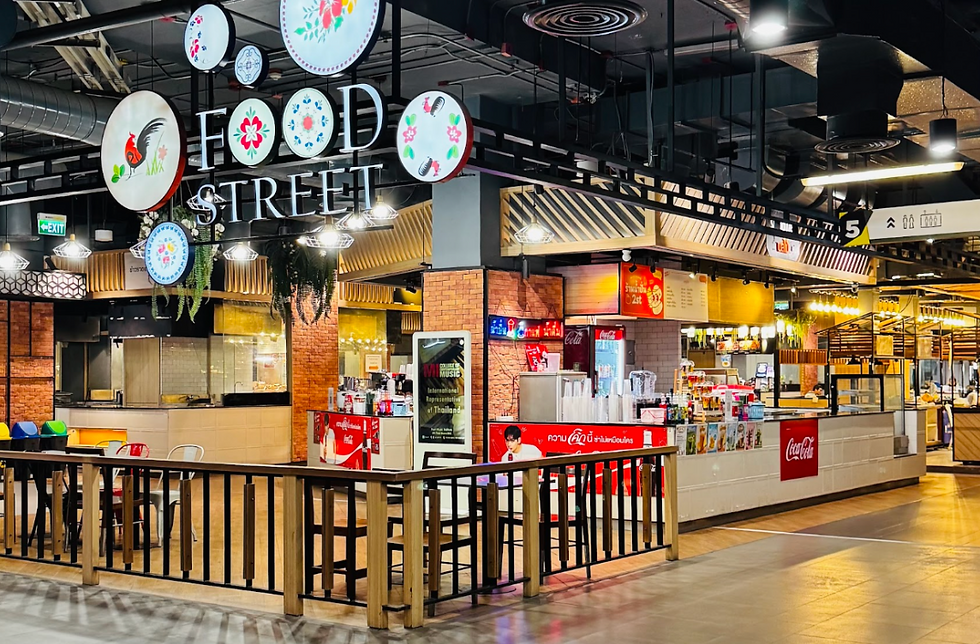
Food and facilities: right around the IdeaLive entrance on the 5th floor, it's mostly Thai food stalls — don't expect familiar Western chains up there on show day.
If you want something more recognisable, there is a small McDonald's outlet and a small Starbucks outlet, but both are down on the ground floor.
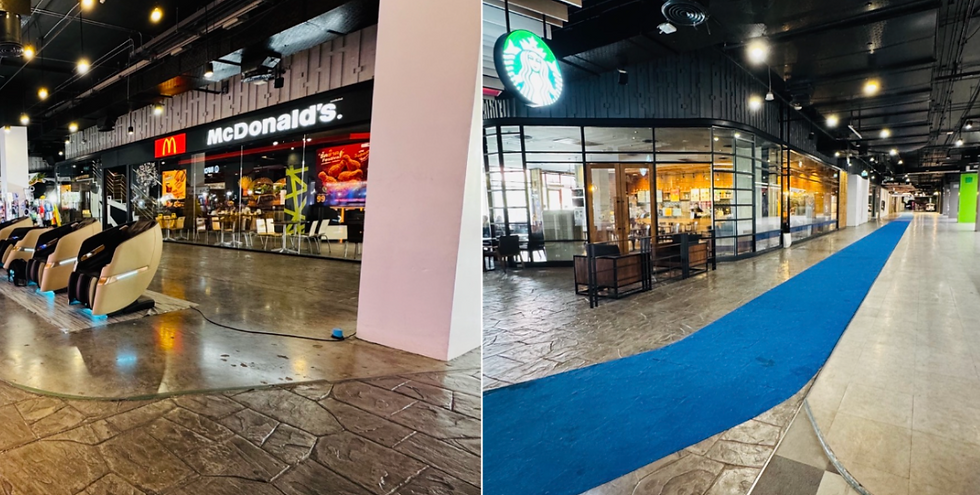
Worth factoring into your plans: if you want a coffee or a familiar meal before the show, grab it on your way in, because fighting the crowd flow back down from the 5th floor later isn't going to be fun.
Transport to the venue
This is one of the more interesting wrinkles of the whole Bangkok plan, and it's worth breaking down by starting point.
From Suvarnabhumi Airport: take the Airport Rail Link (the Airport Express service) and get off at Makkasan Station.
From there, you've got two main options: a ride-hailing app or a motorcycle taxi. Grab is the most widely used app in Thailand and the safest bet for reliability, especially around airports, but it's worth also having Bolt installed — it's regularly 10 to 25 percent cheaper than Grab on the same route — and inDrive, which lets you negotiate or set your own price with the driver rather than accepting a fixed fare.

A short ride-hailing trip from Makkasan to Bravo BKK should land somewhere in the 60 to 150 baht range depending on traffic, time of day, and which app you check. Motorcycle taxis (look for the orange-vested "win" drivers at a stand) are the faster and often cheaper option for short hops — typically 20 to 60 baht for a quick trip, though it's a negotiated fare, not metered, so confirm the price before you get on.
One thing worth knowing regardless of which app you use: it's common for the car driver to ask, once the trip starts, whether they can take the expressway, and to tell you upfront what the toll fee will be.
If you agree, that toll amount gets added to the total fare at the end rather than folded into the quoted price or if you have cash, just hand over the amount.
It's a normal part of getting around Bangkok, not a scam, but it does mean the final amount can end up a bit higher than what the app first showed you.
From Asoke MRT: same two options apply — a ride-hailing app (Grab, Bolt, or inDrive) or a motorcycle taxi from a stand near the station exit.
Expect similar pricing to the Makkasan leg for a short trip. Note that Asoke and Makkasan are interchange stations that are connected by a walkway.
Walking it — can it be done?
I tried walking from Bravo BKK to Asoke MRT myself, out of curiosity, and yes — it's technically doable, but I wouldn't recommend it as a real option for most fans, especially on show day.

The safest route takes you past a neighbourhood Wat (a local Buddhist temple), across an active railway line with real train traffic, through a residential compound, and finally along a sidewalk running beside a busy main road.
None of it is dangerous exactly, but it's not a designed pedestrian route either, and in Bangkok's heat and humidity it turns into a genuinely draining walk.
If you're dressed for a show, carrying anything, or just don't want to arrive drenched in sweat, take the motorcycle taxi or a ride-hailing app instead.
The second route is walking on a small road with no sidewalk, no tree shade and rushing vehicular traffic. Walking is a "because I could" story, not a practical transport recommendation.
The equatorial heat of Bangkok is legendary.

Where's the Eurovision Village? (And why is there zero buzz around the mall?)
Every European hosting of Eurovision comes with a "Eurovision Village" — a free, public fan zone with big screens, food, merch, and live performances, usually set up somewhere central so locals and tourists alike can soak up the atmosphere without a ticket.
It's a huge part of how host cities drum up local interest in the weeks before the contest. As of now, nobody has announced anything like this for Eurovision Asia in Bangkok.
Here's an honest observation from actually being on-site at the last week of July: there is currently no visible promotional material anywhere around Bravo BKK — no banners, no countdown signage, no posters, nothing that would tell an ordinary shopper walking through the mall that the first-ever Eurovision Asia Grand Final is happening on the 5th floor in a few months.
For an event of this scale, that's a striking absence, and it raises a real question about how much local buzz is actually being built right now versus how much will get compressed into the weeks immediately before November 14.
If a Eurovision Village does get set up, MGI Hall is a logical candidate — it's the biggest hall in the building, one floor above IdeaLive, and already has the LED-wall infrastructure to host a public-facing fan zone without interfering with the main show upstairs.
But to be clear, this is speculation based on the building's layout and how these things are normally run in Europe, not anything announced or confirmed by organisers. If you're reading this closer to November and there's still no Eurovision Village and no mall-wide signage, that alone would be a notable story in itself.
The mystery upstairs: MGI Hall
Bravo BKK isn't a one-hall building — IdeaLive isn't even the biggest room in it. That title goes to MGI Hall, one floor up on level 6, at roughly 4,165 square meters.
MGI Hall is the home turf of the Miss Grand International pageant crew, known for elaborate LED-wall stage production, and it hosted Miss Grand Thailand 2024 with 77 delegates competing.
Given it's one floor above the contest hall, MGI Hall is an obvious candidate for rehearsal space, delegation holding areas, or press operations — exactly the kind of thing Vienna does as standard practice, spreading rehearsals, press, and green-room prep across its other halls while Hall D runs the live shows.
But nobody has confirmed Bangkok is doing the same. There's no announced deal, no statement, nothing — just a very plausible guess based on the floor plan.
What has this venue even hosted before?
IdeaLive's concert history so far skews K-pop and international rather than homegrown Thai acts: Taemin's Ephemeral Gaze tour stop in September 2024, a Dream Theater show in February 2026, I.O.I's Loop tour in June 2026, and a Park Jihoon fan-meeting in July 2026.
MGI Hall upstairs sees a lot more Thai-audience programming — pageant events and K-pop-adjacent fan meets are its bread and butter.
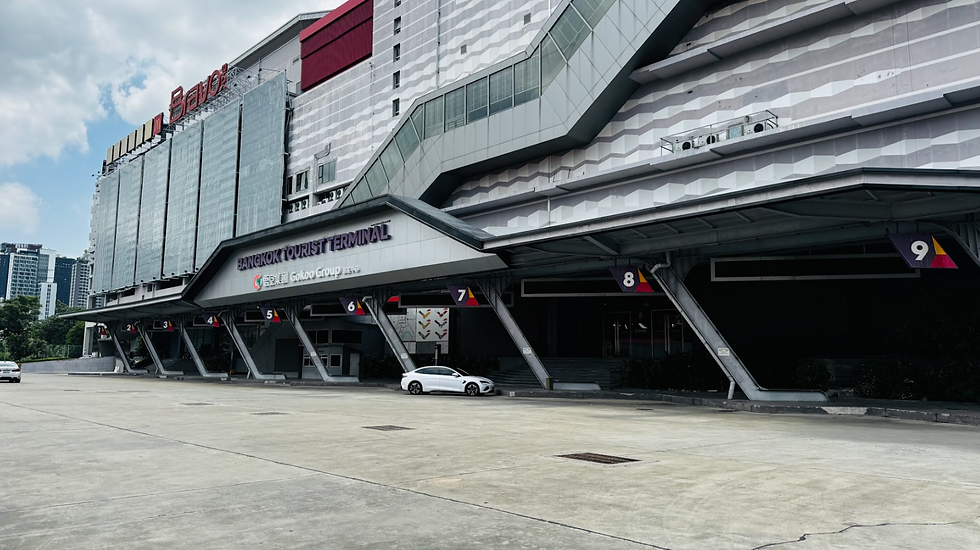
The production logistics nobody's talking about yet
This is the biggest information gap in the whole story. As of now, there are no published numbers on Bangkok's production plan — no truck counts, no rigging weight, no crew size, no security timeline.
For a first-time event still months out, that's not shocking, but it makes it hard to know what we're actually in for.
For contrast, Vienna's 2026 load-in has been documented in almost absurd detail: about 3,500 tons of material, delivered by hundreds of vehicles, 27 broadcast cameras, 8,500 LED spotlights, and 35 companies working round-the-clock shifts — followed by a full venue lockdown with airport-style security screening before delegations arrive.
Bangkok's version will almost certainly be smaller given the venue size difference, but by how much is anyone's guess until organisers start talking numbers.
So where does this leave us?
Eurovision Asia's first edition is starting from a genuinely different place than European hosts typically do — smaller room, no prior Eurovision experience, a vertical crowd-flow challenge that's going to need real planning, and a location that's more "figure it out" than "well-oiled machine" when it comes to transport.
None of that is a knock on the choice; first editions of anything tend to scale up over time.
But if you're the kind of fan who likes to track the behind-the-scenes machinery of how these shows actually get built — and especially if you're planning to attend in person — the practical advice right now is: budget extra time for getting up to the 5th floor, know your exit letter before you need it, and don't try the scenic walk to Asoke MRT unless you genuinely enjoy the heat.
For continued updates on all Eurovision Song Contest and Eurovision Asia news, follow us on Facebook, Twitter, TikTok, YouTube, Threads, Bluesky and Instagram. All the links can be found at: https://linktr.ee/aussievisionnet


