
Looking back at Eurovision – Australia Decides 2019: Australia’s inaugural national final

Updated: Feb 9

Looking back, Australia has come a remarkably long way in its relationship with the Eurovision Song Contest.
Planning for Eurovision – Australia Decides began in the aftermath of Eurovision 2017 in Kyiv. While launching the show in 2018 was considered, it was ultimately deemed too soon to do it justice. Instead, the decision was made to wait until 2019 — a symbolic moment that closed the chapter on Australia’s era of internal selections, following Jessica Mauboy’s final internally selected entry (at the time).
The idea of hosting a homegrown Eurovision national final was once something many Australian Eurofans could barely imagine. Yet in 2019, that long-held dream became a reality.
Between 2019 and 2022, Australia staged three editions of Eurovision – Australia Decides, firmly cementing the country’s unique place within the Eurovision world.
Now, seven years on from the inaugural Australia Decides, we mark the anniversary by revisiting Australia’s first-ever Eurovision national final and exploring five key takeaways from the night that started it all.
1. Australia's very own mini-Eurovision
For Eurovision fans in Australia, the idea of running a national final was once little more than a dream. Eurovision – Australia Decides gave fans across the country a rare opportunity to come together and celebrate their shared love for the Contest.
With Australia so far removed from Europe, attending the Eurovision Song Contest in person is something many Aussie fans may never experience — a reality that made Australia Decides all the more special. For once, fans were also able to watch a national final at a “normal” evening time slot, rather than in the early hours of the morning. In a small way, it gave European Eurofans a taste of what Australians have long endured to follow a Eurovision national final live.
To the surprise of many, the event truly felt like a mini-Eurovision. From its impressive production values and energetic live audience to the Eurovision-themed after-parties, the atmosphere captured the spirit of the Contest in a uniquely Australian way.
After the inaugural Eurovision – Australia Decides in 2019, fans were already counting down to the next edition — the perfect excuse to return to the Gold Coast and reconnect with Eurovision friends.
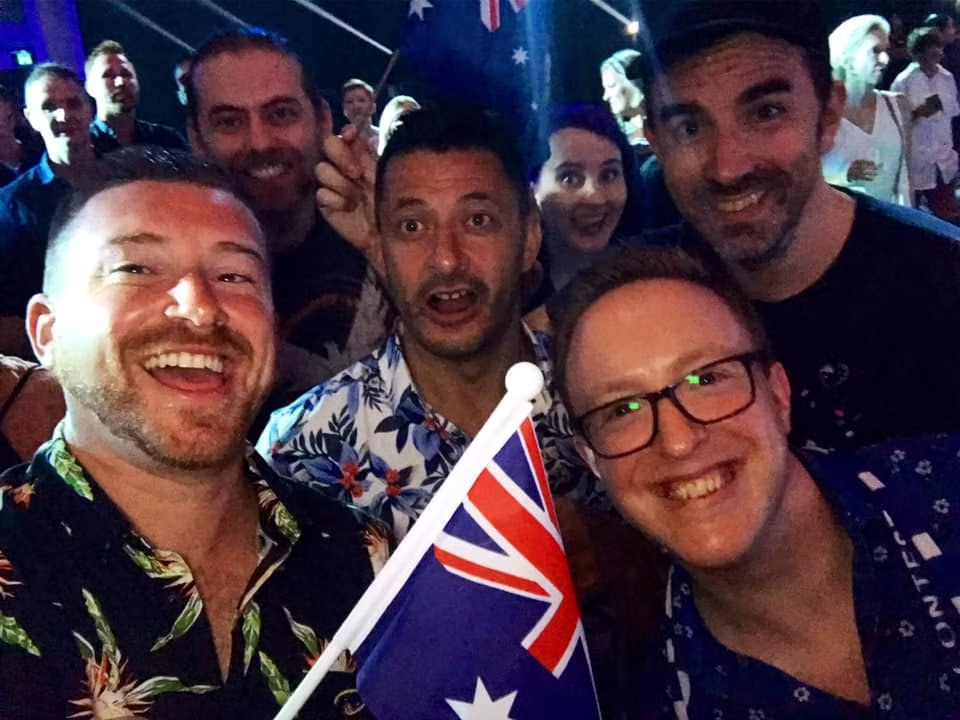
In 2019, only Mike and Dale were on the ground representing Aussievision. Following a call-out for volunteers, the following year saw dozens of team members descend on the Gold Coast, many meeting face-to-face for the very first time.
2. Exposure to established and emerging Australian artists
Eurovision – Australia Decides proved to be a powerful platform for artist exposure and promotion.
The show became a showcase for both established names and rising talent within the Australian music industry, offering something for every type of viewer. For household-name artists, it provided an opportunity to reconnect with fans and introduce themselves to a new generation of audiences.
Artists such as Ella Hooper of Killing Heidi and Tania Doko from Bachelor Girl — both of whom enjoyed major chart success in the late 1990s and early 2000s — returned to the spotlight alongside familiar faces like Courtney Act from the original Australian Idol era. Nashville-based band Sheppard, originally from Brisbane, also brought their international experience to the stage, having previously scored a global hit with Geronimo in 2014.
At the same time, Australia Decides offered invaluable exposure to younger and less-established artists. Acts like Aydan and Leea Nanos were given a national platform to showcase their music and begin building dedicated fanbases.
The show also allowed artists such as Electric Fields to bring their distinctive sound and the use of Indigenous language to mainstream audiences, highlighting the diversity and richness of Australian music on a national stage.
3. Kate Miller-Heidke delivers one of Eurovision’s biggest glow-ups

Eurovision – Australia Decides 2019 is perhaps best remembered for its showdown between Kate Miller-Heidke’s pop-operatic entry Zero Gravity and Electric Fields’ dance-floor anthem 2000 and Whatever.
In the end, Kate’s soaring vocals and unforgettable staging — complete with a towering gown and dramatic, "dementor-like" acrobats billowing behind her — proved irresistible. She swept both the jury and televote, claiming victory at the inaugural Australia Decides.
Her next challenge was taking Zero Gravity to the Eurovision stage in Tel Aviv, and Kate arrived with an ambitious vision.
Training with Melbourne-based performance company Strange Fruit, Kate learned to sing while suspended on a “sway pole”, transforming herself into what she described as “a vision of wheat swaying in the breeze”. Paired with her breathtaking Steven Khalil gown, which took over 100 hours to create, Zero Gravity evolved into a performance unlike anything Eurovision audiences had seen before.
The risk paid off. Kate won her Eurovision semi-final — only the second time Australia had achieved this at the time — and went on to finish in the top 10 of the Grand Final. She also received the prestigious Marcel Bezençon Artistic Award, recognising excellence in artistic performance.
4. Australia Decides: A launchpad for Eurovision journeys
Australia Decides has firmly established itself as a stepping stone within Eurovision, leaving a lasting legacy.
Many artists, performers, and songwriters who took part in the 2019 edition have gone on to further their Eurovision journeys, whether through national finals, songwriting, or the Contest itself.
Electric Fields, runners-up in 2019, continued their Eurovision path by serving as Australia’s jury spokespersons at the 2019 Grand Final. After years of fans requesting they compete, they finally represented Australia at Eurovision 2024 in Basel with One Blood (One Milkali).
Courtney Act went on to become Australia’s Eurovision commentator alongside Tony Armstrong in 2024 and has publicly expressed interest in representing Australia in 2027, a prospect fans are eagerly watching.

Alfie Arcuri, who finished 5th in 2019 with To Myself, co-wrote Cyprus’ Eurovision 2020 entry Running for Sandro and later competed in San Marino’s national final Una voce per San Marino 2023 with his self-penned ballad Collide, winning the Critics’ Award despite finishing outside the top 10.
Tanzer, the Melbourne-based guitarist for Ella Hooper’s 2019 entry Data Dust, later auditioned for San Marino’s Una voce per San Marino 2022, marking her own Eurovision journey.
George Sheppard (of Sheppard) and Tania Doko co-wrote Pushing Stars for Australia Decides 2022, performed by Jordan-Ravi, finishing 10th. George later co-wrote Australia’s Eurovision 2025 entry Milkshake Man with Amy Sheppard, longtime collaborator Jason Bovino, and Go-Jo.
Leea Nanos, who wowed audiences in 2019 with Set Me Free, co-wrote the 2022 Australia Decides song Bite Me for girl band G-Nat!on and has been mentioned as a potential Eurovision representative for Cyprus or Greece.
Isabella Kearney, co-writer of Mark Vincent’s 2019 entry This Is Not the End, returned as a co-writer for Mitch Tambo’s Together in 2020 and competed in Ireland’s 2024 national final Eurosong with her own song Let Me Be the Fire, finishing 6th.
Through its first edition alone, Australia Decides has proven to be more than a competition — it’s a launchpad for careers, a showcase for talent, and a springboard into the international Eurovision arena.
5. Unforgettable interval acts
Eurovision – Australia Decides 2019 delivered not only a competitive lineup but also a memorable selection of interval performances that added to the spectacle of the night.
The show opened with an energetic performance from Australian Idol winner Casey Donovan, who took on Guy Sebastian’s Tonight Again — Australia’s very first Eurovision entry — setting the tone for the evening.
Eurovision 2016 runner-up Dami Im enchanted the audience, performing tracks from her Live Sessions EP, including a stunning rendition of her iconic Eurovision song Sound of Silence.
Fresh off his run to the quarter-finals of America’s Got Talent, fan favourite Hans — Australia’s adopted German icon — brought his signature flair to the Australia Decides stage with a Eurovision medley that made for truly unforgettable viewing.
These interval performances helped set the benchmark for future editions of Australia Decides, paving the way for international acts to travel Down Under and take part in the celebrations in later years.
Australia Decides may be on hiatus, but it is deeply missed — and many fans continue to hope that one day, it will make a triumphant return.
Do you have fond memories of Eurovision – Australia Decides 2019? Share them with us on our socials.
For continued updates on all Eurovision Song Contest news, follow us on Facebook, Twitter, TikTok, YouTube, Threads, Bluesky and Instagram. All the links can be found at: https://linktr.ee/aussievisionnet


